Bunny Junior leaves the car for food and mistakes a stranger for his mother
The Death of Bunny MunroBunny Junior’s brief search for food on Marine Parade turns an ordinary errand into a crisis of hunger, fear, and mistaken recognition. Left in the Yellow Fiat Punto while Bunny Munro is away, the boy breaks the rule to stay in the car and crosses the promenade for chips. His belief that his dead mother is looking for him shapes the journey: amid the crowd, he takes a stranger for her, clings to her, and runs when she asks where his mother is.
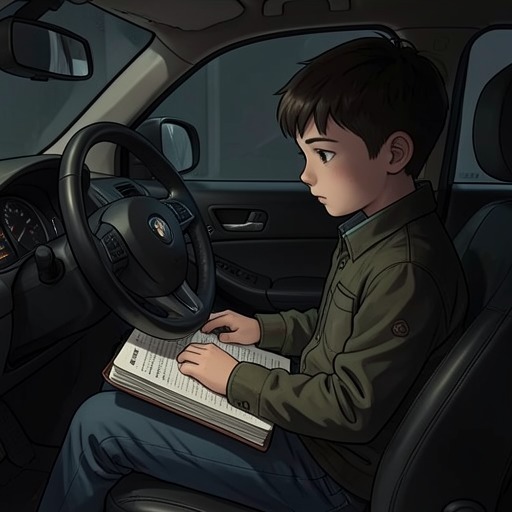
Waiting in the car
Parked on Marine Parade, the Yellow Fiat Punto becomes both shelter and trap. Bunny Junior rests his head against its window, watches people pass, and wonders what he is doing on the trip. He feels he has learned the Patience Law, but not the practical skill he wants Bunny Munro to teach him: how to sell something. That gap makes the lesson feel incomplete, even as he tries to follow it by remaining where he has been left.
His thoughts turn from the sales journey to his body and his mother. He worries that advanced blepharitis may make him blind, and that he may also be going insane. In Bunny Junior’s Encyclopaedia, he has looked up both “Mirage” and “Apparition”; their definitions do not help him make sense of what he experiences. He believes his mother is looking for him and has something important to say. He, too, thinks he has something to tell her, but hunger keeps him from remembering what it is.
The immediate cause of his departure is physical and specific. He regrets not eating his Cornish pasty at lunchtime, watches youths pass with chips, and smells fried potatoes and vinegar drifting from a booth across the road. He knows he is forbidden to get out of the car, but fears he will die of hunger if he does not eat. The prospect of his father returning to find him dead even crosses his mind, an absurdly grave test of the Patience Law. He counts to one hundred, checks both directions, and finally opens the door with three one-pound coins in his pocket.
Crossing to the booth
The crossing turns a short walk into a test of nerve. Bunny Junior expects the trip to take two minutes, but reaches the pedestrian crossing just as the red signal appears and waits three full minutes for the green. During the wait, a man in white tracksuit bottoms and a white polo shirt approaches. His plucked eyebrows and thinning black hair, and his remark about taking a sick day, make the encounter feel threatening rather than reassuring. When the light changes, Bunny Junior hurries across without looking back, repeating a swear word under his breath. His fear has displaced his hunger, but he now believes he should never have left the safety of the car.
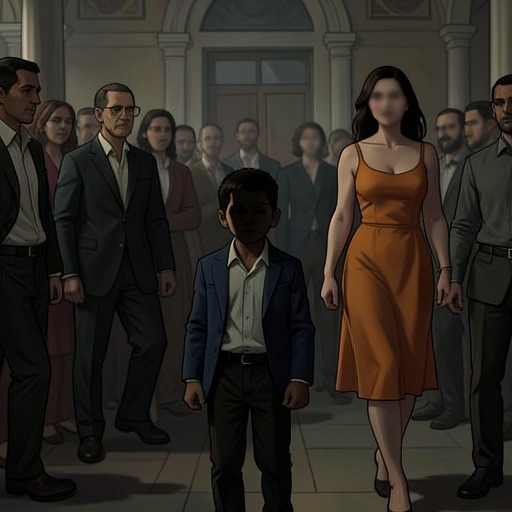
At the fish-and-chip booth, he joins the queue and keeps glancing behind him. The man in the tracksuit is across the road, fiddling with the polo player on his shirt; after seeming to lose interest, he looks up, smiles, and wags a finger at the boy. Bunny Junior turns back to the vendor, whose arms are thickly covered in black hair. He orders chips, asks for vinegar, pays, and receives them in a paper cone. The small, concrete success of buying food does not settle him: as he turns away, he sees a woman in an orange dress, her blonde hair tied in a ponytail, walking down the promenade and takes her for his mother.
Mistaken recognition
The man in the tracksuit appears beside Bunny Junior again and says he might report him to the authorities. The boy recoils, thinking the man wants to eat him, while the woman he believes is his mother disappears into the crowd. He runs after her. In his frightened perception, the people around him look like the undead or aliens: they seem taller, their arms longer, their faces mask-like and their jaws slack. The crowd is not simply an obstacle; it becomes an uncanny landscape through which he tries to follow a familiar figure.
He cannot find the woman on the promenade. Looking over the wrought-iron railing, however, he spots her below, talking with people at an outdoor café and smoking a cigarette. He feels a rush of love and thinks of telling her to put it out. With the cone of chips in hand, he hurries down the stairs toward her. Recognition is the force pulling him forward, but the details of the meeting soon undo it.
Bunny Junior embraces the woman around the waist and rests his head against her stomach. He feels a vast, sad love, yet her body is not as soft as he remembers his mother’s: her stomach seems hard, and her breasts feel small and firm. When she responds with agitation or embarrassment, he senses that something is wrong but cannot make himself let go; instead, he clings more tightly. She struggles free and asks where his mother is.
Only then does the mismatch become unmistakable. The woman’s nose is hooked and brown, her hair mouse-coloured rather than blonde, and her dress pink rather than orange; it smells of cigarettes and old coconuts. When she reaches to touch his head, Bunny Junior jerks back, and she accidentally knocks the paper cone from his hands, scattering the chips across the restaurant floor. He spins away and runs for his life.
Significance of the episode
The episode makes the boy’s need for food inseparable from his need for his mother. Hunger first drives him out of the car; the belief that she is searching for him then redirects the errand into a pursuit. The chips briefly answer the body’s demand, but they do not protect him from the more powerful expectation of reunion. His conviction is enacted through touch: he does not merely see a woman at a distance but reaches for the remembered comfort of his mother’s body, and the stranger’s attempt to free herself makes the error physically painful.
The changing quality of Bunny Junior’s vision also gives the event its unsettled shape. He has already worried that blepharitis is making him blind and consulted definitions of illusions he cannot understand. At the booth, the crowd seems monstrous; at the café, a stranger becomes his mother. The episode does not resolve whether this recognition is driven by impaired sight, grief, fear, or some combination, but it shows how little certainty his surroundings offer him. The repeated separations—first from the car’s refuge, then from the woman swallowed by the crowd, and finally from the stranger he embraces—leave the boy with scattered chips and no reunion.